FRP / GRP Composite Solutions Manufacturer · Supplier · Exporter
A complete range of corrosion-resistant FRP and GRP products — filament wound piping systems, moulded and pultruded gratings, ladder and perforated cable trays, electrical enclosures, canopies, and structural profiles — in isophthalic, vinyl ester, epoxy, and phenolic resin systems. Compliant with ASTM, AWWA, ISO 14692, DIN, BS EN, and IEC standards. Exported globally with full material and test certification.
Understanding FRP & GRP Composite Materials
FRP (Fibre Reinforced Polymer) and GRP (Glass Reinforced Plastic) are two terms used interchangeably across different global markets to describe the same fundamental class of composite materials — thermosetting resins reinforced with glass fibre to create a structural product that is simultaneously lightweight, corrosion-resistant, non-conductive, and capable of being moulded into virtually any geometry. In North American and Asian markets the term FRP is more common, while in the United Kingdom, Europe, and the Middle East the term GRP is used almost exclusively. At Enmetra Industries, we supply both and understand the distinction only as a geographical naming convention — not a technical difference.
The structural performance of an FRP or GRP product is determined by two primary constituents: the resin matrix, which provides chemical resistance, weather resistance, and fire performance, and the glass fibre reinforcement, which provides mechanical strength, stiffness, and dimensional stability. The combination of these two materials — selected and processed correctly — produces a composite product that can outperform steel, aluminium, and thermoplastics simultaneously in terms of whole-life cost in corrosive industrial environments. The result is a material that weighs approximately ¼ of equivalent carbon steel, resists corrosion permanently without painting or cathodic protection, and achieves a design life of 30–50 years in environments where unprotected steel would corrode through in 2–5 years.
"The whole-life cost advantage of FRP over steel in corrosive industrial service is rarely less than 2× over a 20-year period — and frequently 4× when you include inspection, repainting, and replacement costs that steel requires but FRP does not."
What makes FRP and GRP products particularly relevant to procurement teams working on chemical plants, offshore platforms, water treatment facilities, and desalination projects is their ability to replace multiple materials simultaneously. A single FRP/GRP system from Enmetra can address the piping requirement, the walkway grating, the cable tray routing, and the electrical enclosure housing — all in chemically compatible, weight-matched composite materials from a single supply source with consistent documentation and quality standards.
Resin Systems — The Critical Selection
The choice of resin system is the most technically critical specification decision in any FRP or GRP procurement. The resin determines the chemical resistance envelope of the product, its maximum service temperature, its fire performance classification, and its suitability for use in classified hazardous areas. A product manufactured with the wrong resin will degrade, blister, delaminate, or fail — regardless of how well the glass fibre architecture is constructed. Enmetra supplies five primary resin systems, each suited to a defined range of service conditions, and our technical team will confirm the correct resin selection for your specific process fluid and temperature before any quotation is issued.
Isophthalic polyester resin is the most widely used and most economical FRP/GRP resin for general industrial applications. It offers good resistance to dilute acids, alkalis, salts, and water, and is the standard choice for water treatment pipework, drainage systems, irrigation infrastructure, and general industrial walkway gratings. It achieves ASTM E84 Class I fire performance in fire retardant (FR) grades and is the default resin for AWWA C950 filament wound pipe supply to the water and wastewater market. Orthophthalic polyester is available as an economy grade for non-chemical applications, though isophthalic is recommended as the minimum standard for any industrial or outdoor service.
Vinyl ester resin is the premier choice for chemical plant FRP piping, gratings, and enclosures. Its superior resistance to strong acids (HCl, H₂SO₄, HNO₃), strong alkalis, organic solvents, and oxidising chemicals makes it the standard specification for chemical process plants, offshore topsides, FGD scrubber systems, acid mine drainage infrastructure, and bleach handling facilities. Vinyl ester achieves ASTM E84 Class I fire performance as standard in FR grades, IEC 60332-3 Category C for cable tray fire bundle tests, and UL94 V-0 for enclosure fire performance. It operates continuously to +110°C and withstands short-term excursions to 150°C, making it suitable for the majority of industrial process chemical services.
Epoxy resin — which forms the basis of GRE (Glass Reinforced Epoxy) pipe systems — is the premium choice for oil and gas service, particularly for offshore produced water injection lines, firewater mains, seawater lift systems, and chemical injection tubing manufactured to ISO 14692. GRE epoxy systems achieve pressure ratings significantly higher than polyester-based systems — up to 50 bar and above with ISO 14692 qualification testing — and provide excellent resistance to hydrocarbons, crude oil, produced water, and aliphatic solvents. Epoxy resin also offers the best inherent surface resistivity properties of all FRP resins, making it the preferred choice for ATEX Zone 1 IIC classified applications where the surface resistivity requirement of ≤10⁹ Ω per EN 60079-0 must be met.
Phenolic resin is specified where fire performance is the primary design driver — typically for marine vessels subject to SOLAS regulations, offshore accommodation modules requiring IMO A.653(18) compliance, tunnel ventilation systems, and any installation where the consequences of fire spread are severe. Phenolic FRP achieves self-extinguishing performance with low smoke emission, low toxic gas generation per BSS 7239, and low flame spread — properties that polyester and even vinyl ester resins cannot reliably achieve. The operating temperature capability of phenolic resin extends to +200°C continuously, making it also suitable for high-temperature duct and structural applications in power generation and process plant environments.
FRP / GRP Piping Systems
Our FRP and GRP piping range is manufactured by continuous filament winding — a process in which CNC-controlled winding machines lay continuous E-glass or ECR-glass roving onto a rotating mandrel at precise helical and hoop winding angles while simultaneously impregnating the glass with catalysed resin under controlled temperature conditions. The resulting pipe has a defined fibre architecture — typically ±55° helical winding for balanced hoop and axial strength in pressure service, or ±75° for high-pressure predominantly hoop-loaded applications — that provides predictable, engineered mechanical performance across the full range of operating conditions.
The wall construction of a filament wound FRP pipe consists of three functional layers. The chemical-resistant inner liner — typically 2.0–3.0 mm of resin-rich glass veil or C-glass mat — provides the primary corrosion barrier between the process fluid and the structural laminate. The structural wall of continuous E-glass or ECR-glass winding provides the pressure-containing capability, with wall thickness calculated per the design standard (ASTM D2996, ISO 14692, or DIN 16965) to achieve the specified pressure rating at the operating temperature. The UV-resistant outer coat — a resin-rich pigmented gel coat or UV-stabilised topcoat — protects the structural laminate from ultraviolet degradation in outdoor applications and provides a smooth, cleanable external surface.
Our filament wound FRP pipe is available from DN 25 (1″) through to DN 1200 (48″), in pressure ratings from PN 6 through PN 25 — and in higher ratings up to 50 bar for GRE epoxy systems qualified per ISO 14692. The stiffness class range covers SN 1250, SN 2500, SN 5000, and SN 10000 per ISO 7685, serving applications from gravity sewer installation to high-pressure process piping. Joint types include bell-and-spigot (GJ/BJ), butt-and-wrap laminated joints (the most common for chemical plant service), flanged connections (flat face only for GRP), and adhesive-bonded spigot joints.
Complementing the pipe range, our complete GRP fittings range — elbows (45° and 90°, long radius), reducers (concentric and eccentric), equal and reducing tees, stub ends, end caps, and couplings — is manufactured from the same resin system and glass fibre specification as the parent pipe. This is essential: mixing resin systems between pipe and fittings creates thermal expansion mismatches, incompatible chemical resistance boundaries, and documentation inconsistencies that create problems during fabrication inspection and pressure testing. Every fitting is hydrostatically tested at 1.5 × rated pressure before despatch, with test certificates supplied as standard. GRP flanges are always supplied flat face (FF) — a critical point that is frequently overlooked when transitioning from metallic piping: GRP flanges must never be drilled for raised face, and full-face gaskets with controlled bolt torque are mandatory at every GRP flange joint.
FRP / GRP Gratings & Walkways
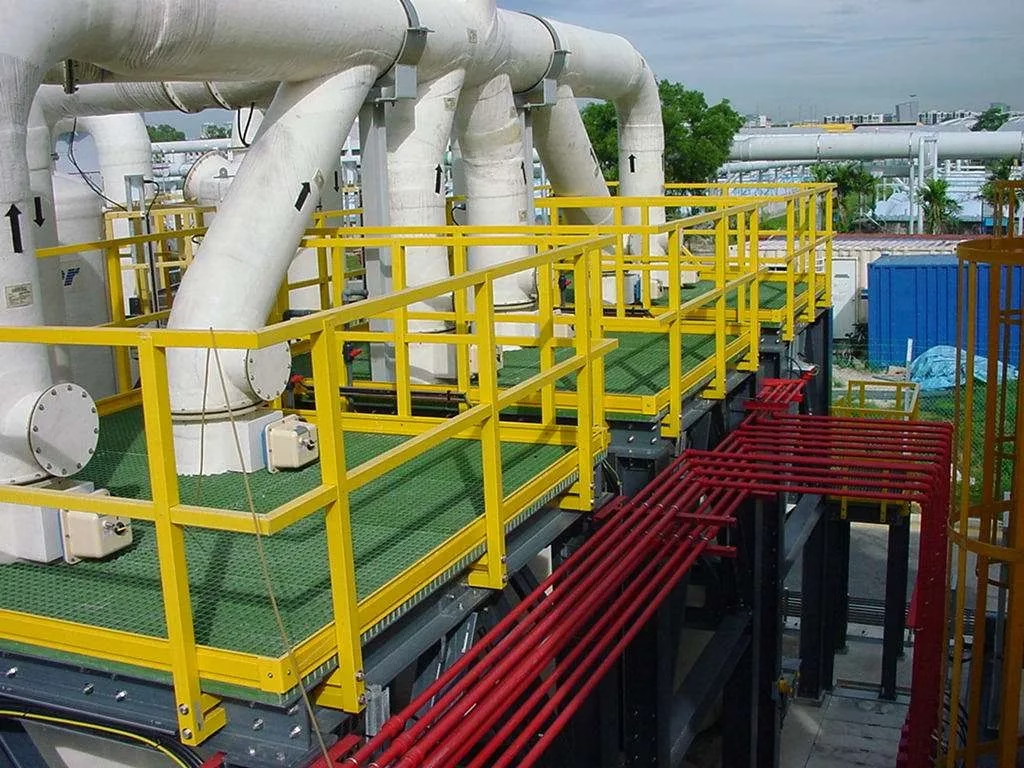
FRP and GRP gratings are one of the most commercially successful applications of composite materials in industrial infrastructure — and for good reason. In chemical plants, offshore platforms, water treatment works, and mining facilities, walkway gratings are exposed to the same corrosive atmosphere as the process itself. A painted steel open-bar grating in an acid plant atmosphere requires inspection every 12–18 months and repainting every 2–3 years to maintain its structural integrity. A hot-dip galvanised steel grating in a chlorine or acid environment will fail significantly faster. An FRP or GRP grating in the same environment requires no maintenance at all for 30–50 years. The economic case is straightforward — and becomes even clearer when the cost of scaffold access for maintenance, production downtime during inspection, and disposal of corroded steel panels is included in the total cost comparison.
Enmetra supplies two primary grating types. Moulded GRP grating is manufactured by laying continuous bi-directional E-glass roving in a mould and impregnating with liquid resin — creating a monolithic, one-piece panel with equal strength in both directions, an integral concave gritted anti-slip top surface, and mesh sizes of 25×25 mm, 38×38 mm, or 50×50 mm in panel depths of 25 mm, 38 mm, or 50 mm. The equal biaxial strength of moulded grating makes it ideal for applications with variable loading direction, and the integral anti-slip surface — moulded in, not added on — achieves R11 to R13 slip resistance per DIN 51130 permanently. Pultruded GRP grating uses pultruded I-bar load bearing members interlocked with transverse cross rods, providing unidirectional structural capacity significantly higher than moulded grating at the same depth, with support spans of up to 3600 mm for 100 mm depth I-bar under heavy industrial loading per IEC 61537.
All FRP grating supplied by Enmetra in fire retardant resin achieves ASTM E84 Class I (flame spread index ≤25), DIN 4102 Class B1, and IEC 60332-3 compliance — the minimum fire safety classification required for all industrial platform and walkway installations. For marine vessel and offshore accommodation applications, phenolic resin grating achieves IMO Resolution A.653(18) and BSS 7239 low smoke density compliance per SOLAS Chapter II-2 requirements. Our complete walkway system supply includes grating panels, pultruded GRP handrail posts and rails (1050 mm height per EN ISO 14122-3 and OSHA 1910.29), GRP toe boards, stair treads with yellow nosing strips, trench covers, and SS 316 saddle clip fixing systems.
FRP / GRP Cable Trays
The corrosion of metallic cable trays is one of the most pervasive and underestimated maintenance costs in industrial electrical infrastructure. A hot-dip galvanised steel cable tray in a chemical plant acid atmosphere or an offshore marine environment will begin to lose its zinc coating within 3–5 years and develop structural rust within 8–12 years — long before the cables it carries require replacement. The consequence is a premature and expensive cable tray replacement programme that disrupts production, requires scaffold access, and generates significant quantities of corroded steel waste. FRP and GRP cable trays eliminate this maintenance cycle entirely.
Enmetra supplies the complete range of FRP cable tray types — ladder tray (two pultruded side rails with transverse rungs, the highest load capacity and most widely specified type for power cable routes), perforated tray (continuous base with punched apertures, preferred for instrumentation, control, and small-diameter cable runs where continuous cable support is required), solid bottom tray (no perforations, for chemical splash zones and outdoor runs requiring cable protection from above), channel and single-rail tray (for light-duty branch cable routes), and wire mesh basket tray (pultruded GRP rod basket, field-formable, preferred for data centre and instrumentation applications in corrosive environments). All types are available in widths from 100 mm to 1200 mm and side rail depths from 50 mm to 150 mm, with load classes from Class A (50 kg/m) through to Class D (200 kg/m) at 3000 mm support span per IEC 61537 and NEMA VE1 Class 8A through 20C.
A complete GRP cable tray system from Enmetra comprises not only the straight tray sections but the full range of matching fittings — 30°, 45°, 60°, and 90° inside and outside horizontal bends, vertical bends (risers) in 45° and 90° angles, equal and reducing tees, cross pieces, reducers, end caps, and GRP or SS 316 splice plates for joining straight sections. GRP cable tray covers — solid flat, louvred ventilated, and peaked (for rainwater shedding) — are supplied in matched lengths and resin systems. All hardware is SS 316 stainless steel as standard. No galvanised steel bolts or standard carbon steel clips are used in chemical plant or offshore GRP cable tray installations — a technical discipline that is frequently violated by lower-grade suppliers and that leads to corrosion of the fasteners, loosening of the tray joints, and loss of the system's IP and structural integrity.
FRP / GRP Enclosures & Junction Boxes
In corrosive industrial environments, metallic electrical enclosures face the same fundamental problem as metallic cable trays — the corrosion of the enclosure body degrades the IP (Ingress Protection) seal, compromises the integrity of the cable entry glands, and ultimately exposes the internal electrical components to the very atmosphere they were designed to be protected from. A painted steel junction box in a chlorine or H₂S atmosphere may lose its effective IP66 rating within 3–5 years as rust blisters the paint film and lifts the door gasket from its seating. A GRP enclosure in the same environment maintains its IP rating, its dimensional stability, and its chemical resistance for the full 30-year design life — without repainting, without rust, and without replacement.
Enmetra's FRP enclosure range covers the full spectrum of electrical and instrumentation enclosure requirements — standard IP65/66/67 junction boxes for general field wiring and cable termination in sizes from 100×100×80 mm to 800×600×300 mm; IP68 submersible pull boxes for underground, buried, or flood-risk cable junction applications with factory hydrostatic testing at 2× rated depth; ATEX Zone 1 certified junction boxes marked ⊛ II 2G Ex eb IIC T6 Gb for hazardous area installations involving hydrogen, acetylene, and ethylene gas groups in Zone 1 classified areas; instrument and analyser enclosures with thermostatically controlled heating or cooling for field-mounted PLCs, RTUs, and measurement instruments; and GRP equipment canopies and shelters for protecting pumps, valves, and instrument panels from weather, UV, and chemical atmosphere. All ATEX-certified enclosures carry a Certificate of Conformity from a European Notified Body — DEKRA, BASEEFA, or Bureau Veritas — and IECEx certificates for export to Middle East, Australia, and Southeast Asian markets.
Industry Applications
The breadth of Enmetra's FRP and GRP composite product range means that a single supplier can address the entire corrosion-resistant material requirement of a major industrial facility — from the chemical processing plant requiring vinyl ester FRP piping for HCl and H₂SO₄ transfer lines, VE grating on acid-exposed maintenance platforms, and ATEX Zone 1 GRP junction boxes in solvent vapour areas, through to the offshore oil and gas platform requiring ISO 14692-qualified GRE epoxy piping for produced water and firewater service, phenolic FR gratings with IMO A.653 compliance for accommodation module walkways, and IECEx-certified GRP enclosures for wellhead instrument packages.
In the water and wastewater treatment sector, our AWWA C950 isophthalic filament wound FRP pipe — with Hazen-Williams flow coefficient C=150 (permanent, compared to C=100–130 for new steel pipe that decreases over time) — delivers lower pumping energy and lower head loss than steel or concrete alternatives across the full operating life of the installation. In desalination and RO plant construction, particularly across the Middle East and North Africa where seawater chloride concentrations are extreme, our vinyl ester or epoxy GRP piping systems, gratings, and enclosures provide the only maintenance-free solution to the corrosion challenge that coastal environments present to metallic systems. For the mining and minerals processing industry, our vinyl ester FRP piping and gratings are specified for acid mine drainage, heap leach solution, and reagent transfer applications where the combination of highly acidic pH, elevated temperature, and abrasive suspended solids creates a service condition that destroys rubber-lined steel within a fraction of the FRP design life.
FRP / GRP vs Steel — The Case for Composite
The comparison between FRP/GRP and carbon or stainless steel is not a straightforward one, because the correct answer depends entirely on the service condition. FRP and GRP are not universally superior to steel — in high-temperature service above 150°C, in very high-pressure service above 50 bar, or in structural applications where fire survivability under load is required, steel remains the correct material choice. However, in the specific conditions that define the majority of chemical, offshore, water, and marine industrial applications — corrosive service, moderate temperature, moderate pressure, weight sensitivity, and low maintenance budget — FRP and GRP consistently deliver a lower total cost of ownership than any metallic alternative.
| Property | FRP / GRP (VE) | Carbon Steel (HDG) | SS 316L | HDPE | Verdict |
|---|---|---|---|---|---|
| Density (g/cm³) | 1.85 | 7.85 | 8.0 | 0.95 | FRP = ¼ weight of steel |
| Corrosion — Chemical | Excellent | Poor | Good | Good | FRP / SS / HDPE win |
| Electrical conductivity | Non-conductive | Conductive | Conductive | Non-conductive | FRP / HDPE safer |
| Non-magnetic | Yes | No | Yes | Yes | FRP preferred near instruments |
| Max. service temp. | +110°C (VE) | +425°C | +450°C | +60°C (pressure) | Steel wins for high temp |
| External painting | Not required | Mandatory (ongoing) | Not required | Not required | FRP / SS / HDPE win |
| Cathodic protection | Not required | Required (offshore) | Not required | Not required | FRP saves CP cost |
| Design life (corrosive) | 30–50 years | 5–15 years | 20–35 years | 30–50 years | FRP / HDPE comparable |
| Whole-life cost (20yr) | Lowest | Highest | Medium | Low–Medium | FRP wins in corrosive service |
The decision to specify FRP or GRP over steel is ultimately an engineering and financial one that must be made with a complete understanding of the service condition, the total cost of ownership over the project asset life, and the specific technical limitations of composite materials in extreme service conditions. Enmetra's technical team is available to support that evaluation at the specification stage — providing resin compatibility confirmation, design life estimates, standard compliance confirmation, and whole-life cost comparisons to support your procurement and engineering decision-making process.
Our Complete FRP / GRP Product Range
Every FRP and GRP product supplied by Enmetra Industries is available with full raw material batch documentation, resin content verification, hydrostatic or load test certification, fire test certificates, and dimensional inspection records. Third-party inspection by SGS, TÜV, Bureau Veritas, Lloyd's, or RINA is arranged on request, with factory acceptance test (FAT) witnessed inspection available for critical or large-volume orders.
Why Engineering Teams Choose Enmetra
For FRP and GRP composite procurement, the supplier's technical credibility — particularly resin compatibility confirmation, standard compliance, and fire performance documentation — matters as much as the product price.
Ready to specify your FRP / GRP system?
Send us your product category, resin system, size range, service fluid, and export destination — we will respond within 24 business hours with a complete technical and commercial offer backed by full certification scope.