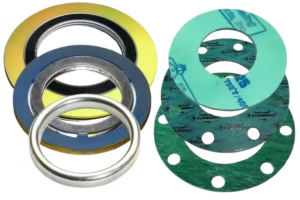
Gasket Types — Full Range
All gasket types available with full material traceability, dimensional inspection reports, and EN 10204 3.1/3.2 certificates. Custom sizes and non-standard materials on request.
Solid metal rings that seat in machined grooves on RTJ flanges. Provide a positive metal-to-metal seal. Preferred for high-pressure, high-temperature, and sour service (H₂S / CO₂).
- Ring ProfilesOval (R) · Octagonal (R) · BX · RX (Pressure-energised)
- Groove DesignationR11–R105 (Oval/Oct) · BX150–BX303 · RX20–RX99
- Size RangeNB ½″ to 24″ (B16.20); up to 20″ (API 6A BX)
- Pressure ClassClass 150 – 2500# · API 2K – 20K (BX)
- MOC OptionsSoft Iron, AISI 316 SS, 304 SS, Duplex, F5, F9, F11, F22, Inconel 625, Monel
- Hardness Reqmt.Gasket must be softer than flange (e.g., Soft Iron: 90 HBW max)
- Temp. Range-196°C to +650°C (MOC dependent)
- FinishBare Metal · Silver Plated · Nickel Plated (API 6A)
Full-face or ring solid metal gaskets for very high temperature and high pressure. Suitable where soft or composite gaskets cannot withstand service conditions.
- TypesFull Face (FF) · Ring / Inside Bolt Circle (IBC)
- Size RangeNB ½″ to 60″
- Pressure Class150# to 2500#
- Thickness1.5 mm / 3.0 mm / custom
- MOC OptionsSoft Iron, CS, 304, 316, 321, 347, Duplex 2205, Titanium, Copper, Monel
- Surface FinishSmooth / Concentric serrated / Spiral serrated
- Temp. RangeUp to +900°C (MOC dependent)
Soft filler material (CAF, ceramic, graphite) encased in a thin metal jacket. Combines compressibility of soft fillers with the protection and blowout resistance of metal.
- Jacket ProfilesSingle Jacket · Double Jacket · Corrugated · Grooved
- Jacket MaterialsSS 304/316/321, CS, Copper, Monel, Inconel, Titanium
- Filler MaterialsCAF (Compressed Asbestos-free) · Ceramic · Flexible Graphite · PTFE
- Size RangeNB ½″ to 60″
- Pressure Class150# to 900#
- Temp. Range-200°C to +550°C (graphite fill); up to +1000°C (ceramic fill)
RTJ Ring Profile Selection Guide
Choose ring profile based on flange rating, groove type, and service — Oval seals by line contact; Octagonal seals on flat groove faces; BX/RX for pressure-energised API wellhead service.
| Profile | Groove Face | Pressure Class | Sealing Action | Preferred Service | Interchangeable? |
|---|---|---|---|---|---|
| Oval (R-series) | Trapezoidal / Oval groove | 150# – 2500# | Line contact on two rings | General HP/HT process | With Octagonal in same groove |
| Octagonal (R-series) | Trapezoidal groove only | 150# – 2500# | Flat face contact | Higher sealing efficiency than Oval | With Oval in trapezoidal groove |
| BX (API) | API 6A BX groove | 2000 – 20000 PSI | Pressure-energised self-sealing | Wellhead, Christmas tree, HP subsea | NOT interchangeable with R-series |
| RX (API) | API R trapezoidal groove | 2000 – 15000 PSI | Pressure-energised, R-compatible | Upgraded HP service on R-groove flanges | Replaces R-series in same groove |
| SRX (API) | API R trapezoidal groove | 5000 – 20000 PSI | Extreme pressure-energised | Subsea, ultra-HP wellhead | NOT interchangeable with R |
V-shaped metal winding strip alternated with soft filler material. Most versatile semi-metallic gasket — excellent for high temperature, thermal cycling, and fluctuating pressure. Available in five configurations.
- Types / Config.Basic (no rings) · With inner ring · With outer ring · With both rings · With inner ring only (for tongue & groove flanges)
- Winding StripSS 304 / 316 / 316L / 321 / 347 / 310 · Duplex · Monel · Inconel 600/625 · Titanium · Hastelloy C276
- Filler MaterialFlexible Graphite (most common) · PTFE · Ceramic (high temp) · Mica · CAF (non-asbestos)
- Inner Ring MOCSS 304/316/321 · Duplex · CS · Monel (prevents inward buckling)
- Outer Ring MOCSS 304 / CS (centering ring — provides compression stop)
- Size RangeNB ½″ to 60″
- Pressure Class150# to 2500# · ASME B16.20
- Temp. Range-200°C to +1000°C (filler-dependent): Graphite to +450°C oxidising / +650°C non-oxidising
- Colour CodePer ASME B16.20 — Outer ring: Green (304), Yellow (316), Blue (CS), Red (Alloy)
- Face TypesRF · FF · RTJ groove · Tongue & Groove · Male & Female
Solid metal core with concentric serrations (grooves) on both faces, overlaid with a thin soft sealing layer (graphite or PTFE). Reusable — the metal core can be refaced and the overlay replaced. Excellent for heat exchangers and large bore flanges.
- Core MaterialsSS 304 / 316 / 321 · CS · Duplex 2205/2507 · Titanium · Hastelloy · Inconel
- Overlay (Facing)Flexible Graphite (standard) · Pure PTFE · Corrugated Graphite · Mica · Ceramic
- Sealing SurfaceConcentric serrations (0.5mm pitch, 0.25mm depth typical) — provides multiple line-contact seals
- Size RangeNB ½″ to 60″ · Heat Exchanger shell/channel nozzles up to 2000mm ID
- Pressure Class150# to 2500# · Special designs to 900 Bar
- Temp. Range-200°C to +650°C (graphite overlay) · -200°C to +260°C (PTFE overlay)
- ReusabilityMetal core reusable after refacing — significant cost saving over full replacement
- Face TypesRF · FF · T&G · M&F · Heat Exchanger (HE) custom profiles
Thin corrugated metal sheet gasket with or without soft facing. Multiple concentric corrugations provide multiple sealing lines. Lower seating stress required compared to flat metal gaskets.
- Metal OptionsSS 304 / 316 / 321 · CS · Copper · Monel · Titanium
- Facing OptionsBare metal · Graphite faced · PTFE faced · CAF faced
- Size RangeNB ½″ to 60″
- Pressure Class150# to 600#
- Temp. Range-200°C to +450°C (with graphite) · Up to +1000°C (bare metal)
- Face TypesRF · FF · Tongue & Groove
Spiral Wound Gasket — Configuration Selection
| Configuration | Inner Ring | Outer Ring | Flange Face | Typical Application |
|---|---|---|---|---|
| Basic (Type A) | No | No | T&G / M&F / RTJ groove | Tongue and groove flanges, confined seating |
| With Outer Ring (Type B) | No | Yes (centering) | Raised Face (RF) | Standard RF flange — most common type |
| With Inner Ring (Type C) | Yes (anti-buckling) | No | T&G / M&F | High vacuum, cryogenic, HP steam |
| With Both Rings (Type D) | Yes | Yes | RF (standard use) | Critical service, HP refinery, ASME preferred |
| HE (Heat Exchanger) | Yes (custom) | Custom ID/OD | Heat exchanger nozzle | Shell & tube HE, channel flanges |
SWG Filler Material Properties
| Filler Material | Max. Temp (Oxidising) | Max. Temp (Non-Oxid.) | pH Range | Suitable For |
|---|---|---|---|---|
| Flexible Graphite | +450°C | +650°C | 0–14 (except strong oxidisers) | Steam, oil, gas, chemicals — most common choice |
| PTFE (Virgin) | +260°C | +260°C | 0–14 (universal chemical resistance) | Aggressive chemicals, acids, caustics, food/pharma |
| Ceramic / Mineral | +1000°C | +1400°C | — | Furnace flanges, very high temp exhaust systems |
| Mica | +800°C | +900°C | — | High temp, electrical insulation required |
| CAF (Non-Asbestos) | +350°C | +400°C | 2–12 | General process, water, steam at moderate conditions |
Compressed Asbestos-Free (CAF) / Compressed Non-Asbestos Fibre (CNAF) sheet gaskets made from aramid, glass, or carbon fibres bonded with NBR, SBR, or EPDM elastomers. Widely used in general process and utility services.
- Fibre TypeAramid (Kevlar) · Glass · Carbon · Mixed mineral fibre
- Binder / ElastomerNBR (oil/hydrocarbon) · SBR (steam/water) · EPDM (chemical/steam) · Neoprene
- GradesBS 7531 Grade X (steam) · Grade BA/BB · KLINGER C-4400 equiv.
- Thickness Range0.5 / 0.8 / 1.0 / 1.5 / 2.0 / 3.0 mm
- Size RangeNB ½″ to 60″ · Full sheet supply: 1500×1500 mm max
- Pressure Class150# to 300# (standard) · Up to 600# with low-emission grades
- Temp. Range-40°C to +400°C (grade dependent)
- Max. PressureUp to 100 bar (grade dependent)
- Face TypesRF · FF (Full Face)
- CertificationsTA-Luft / VDI 2440 (fugitive emission) · FDA (food grade) · BAM (oxygen service)
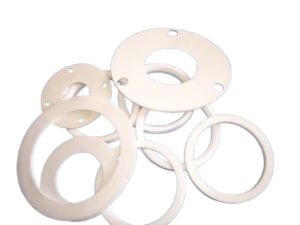
PTFE offers near-universal chemical resistance. Available as virgin PTFE, filled PTFE (glass/carbon/graphite-filled for creep resistance), and expanded PTFE (ePTFE) for low bolt-load and large bore service.
- TypesVirgin PTFE · Filled PTFE · Expanded PTFE (ePTFE / biaxially expanded) · PTFE Envelope (with metal insert)
- PTFE GradesVirgin (white) · 25% Glass-filled (grey) · 15% Carbon-filled (black) · 15% Graphite-filled
- ePTFE FeaturesConformable to flange surface irregularities; seals at low bolt load; no cold flow
- Thickness Range1.0 / 1.5 / 2.0 / 3.0 / 4.5 / 6.0 mm
- Size RangeNB ½″ to 60″ · Full sheet available
- Pressure Class150# to 300# (virgin PTFE) · Up to 600# (filled/ePTFE)
- Temp. Range-200°C to +260°C
- Chemical ResistanceVirtually universal — resists all acids, caustics, solvents except molten alkali metals and fluorine gas
- CertificationsFDA compliant (food/pharma) · BAM (oxygen) · USP Class VI (pharmaceutical)
Natural or synthetic rubber gaskets for low-pressure water, utility, and chemical service. Often used for full face sealing against cast iron or FRP flanges. Also available as rubber-lined steel backed for structural rigidity.
- Natural Rubber (NR)Water, mild acids · Max 80°C · Not suitable for oil
- NBR (Nitrile)Oil, gas, hydrocarbons · -40°C to +120°C
- EPDMSteam, hot water, chemicals · -50°C to +150°C · Not for oil
- Neoprene (CR)Refrigerants, mild chemicals · -40°C to +100°C
- Viton (FKM)Fuels, solvents, chemicals · -20°C to +200°C
- Silicone (VMQ)Food, pharma, high temp · -60°C to +200°C
- Hardness40–80 Shore A (application dependent)
- Size RangeNB ½″ to 60″ · Custom cut from full sheets
- Pressure Class150# (standard) · Up to 300# with reinforcement
Flexible graphite (expanded graphite) gaskets with excellent high-temperature and chemical resistance. Available as plain graphite, or SS/CS foil-reinforced to prevent blowout and handle higher internal pressures.
- TypesPlain graphite sheet · SS 316 foil insert · CS foil insert · Tanged SS insert (anti-blowout)
- Graphite Content≥98% pure carbon (nuclear/chemical grade) / ≥96% (standard grade)
- Thickness Range0.5 / 0.8 / 1.0 / 1.5 / 2.0 / 3.0 mm
- Size RangeNB ½″ to 60″
- Pressure Class150# to 900# (with insert)
- Temp. Range-200°C to +450°C (oxidising) / Up to +3000°C (inert atmosphere)
- Chemical ResistanceExcellent vs. most chemicals, steam, gases. Not for strong oxidisers (fuming HNO₃, H₂O₂)
- TA-Luft ComplianceAvailable — low fugitive emission grades per VDI 2440
PTFE jacket (envelope) fully enclosing a softer insert filler. Provides the chemical resistance of PTFE on the process side with improved compression characteristics from the soft filler core.
- JacketVirgin PTFE (standard) / Modified PTFE
- Insert / FillerCAF/CNAF · Graphite · Rubber · Corrugated SS insert
- TypesFlat envelope · Corrugated insert · Solid PTFE with grooves (modified)
- Size RangeNB ½″ to 24″
- Pressure Class150# to 300#
- Temp. Range-200°C to +260°C
- Use CaseAggressive chemicals where full PTFE creep is a concern; pharmaceutical lines
Gasket MOC Overview
Material selection drives gasket performance. Each MOC has different hardness, corrosion resistance, temperature capability, and compatibility requirements against flange face material.
- Hardness90 HBW max (soft iron) · 120 HBW max (LCS)
- Temp. Range-29°C to +480°C
- UNSK02501 / ASTM A105
- Gasket TypesRTJ (Oval / Octagonal) · Solid flat · Jacketed
- Std.ASME B16.20 · API 6A
- Grades304 / 304L / 316 / 316L / 321 / 347 / 310 / 904L
- Hardness160 HBW max (RTJ winding); standard plate ~180 HBW
- Temp. Range-196°C to +870°C (grade dep.)
- Gasket TypesRTJ · SWG winding & rings · Kammprofile core · Jacketed
- Std.ASME B16.20 / ASTM A240 / A182
- Duplex GradeUNS S31803 / S32205 (2205)
- Super DuplexUNS S32750 (2507) / S32760 (Zeron 100)
- PRENDuplex ≥35 / Super Duplex ≥40
- Temp. Range-50°C to +300°C
- Gasket TypesRTJ · SWG winding/rings · Kammprofile · Solid flat
- Monel 400UNS N04400 — seawater, HF acid, caustics
- Inconel 600UNS N06600 — oxidising & reducing media
- Inconel 625UNS N06625 — offshore, sour gas, seawater
- Hastelloy C276UNS N10276 — strongest acid/chemical resistance
- Temp. Range-200°C to +1090°C (alloy dependent)
- Gasket TypesRTJ · SWG winding · Kammprofile · Jacketed
- GradesPure Copper (C11000) · Cu-Ni 90/10 (C70600) · Cu-Ni 70/30 (C71500)
- Hardness~70 HBW (soft annealed)
- Temp. Range-200°C to +200°C
- Gasket TypesRTJ · Solid flat · Jacketed · Corrugated
- Not SuitableAmmonia, acetylene, moist H₂S service
- Ti GradesGrade 1 (Soft) · Grade 2 (Standard) · Grade 5 (Ti-6Al-4V) · Grade 7 (Pd-stabilised)
- ZirconiumUNS R60702 / R60704
- Temp. Range-200°C to +315°C (Ti) · Up to +350°C (Zr)
- Gasket TypesRTJ · Solid flat · Kammprofile core · Jacketed
- Use CaseChlor-alkali, HNO₃, HCl at all concentrations (Ti), seawater desalination
Gasket Selection Guide
Selection depends on flange face type, pressure class, temperature, fluid medium, and bolting available. Use this table as a starting point — final selection must confirm with design code and fluid compatibility.
By Flange Face Type
| Flange Face | Recommended Gasket Type | Not Suitable | Note |
|---|---|---|---|
| Raised Face (RF) | SWG with outer ring · CAF/CNAF · Graphite sheet · Kammprofile | Full-face rubber (unless FF) | Most common — widest gasket selection |
| Flat Face (FF) | Full-face rubber · Full-face CAF · Full-face PTFE | Ring-only gaskets (IBC style) | Required for cast iron flanges — full face prevents flange rotation |
| Ring Type Joint (RTJ) | Oval / Octagonal RTJ rings · BX / RX (API) | All soft gaskets | Metal-to-metal seal — groove must be clean and undamaged |
| Tongue & Groove (T&G) | SWG without outer ring (Type A/C) · CAF confined ring · Rubber ring | SWG with outer ring | Self-aligning — gasket is fully confined; low blowout risk |
| Male & Female (M&F) | SWG without outer ring · Flat ring CAF/PTFE | Full face gaskets | Gasket seated on female face — confined seating improves reliability |
By Service Conditions
| Service / Medium | First Choice | Alternative | Avoid |
|---|---|---|---|
| Steam (high pressure) | SWG + graphite filler · RTJ | Kammprofile + graphite | Rubber / plain CAF above 200°C |
| Steam (low pressure) | CAF/CNAF (EPDM binder) · Graphite sheet | SWG + graphite | PTFE (creep under low bolt load) |
| Hydrocarbons (oil/gas) | SWG + graphite · RTJ · CAF (NBR binder) | Kammprofile | Natural rubber · EPDM |
| Concentrated acids | PTFE / ePTFE · Hastelloy SWG/RTJ | PTFE envelope · Graphite (not HNO₃) | Rubber · CAF · plain graphite (strong oxidisers) |
| Caustics / Alkalis | PTFE · SWG + PTFE filler · Monel RTJ | CAF (EPDM binder) · Graphite | Copper / Cu-Ni |
| Cryogenic (< -46°C) | SS SWG + graphite/PTFE · RTJ SS/Inconel | PTFE · Metallic flat | Rubber · CAF (becomes brittle) |
| High Temp (>450°C) | RTJ SS/Alloy · Metallic flat · Ceramic SWG | Kammprofile + mica facing | Graphite (oxidation) · PTFE · Rubber · CAF |
| Sour Service (H₂S/NACE) | RTJ per NACE MR0175 · SWG SS316 + graphite | Kammprofile SS316 | Non-SS metals above hardness limits |
| Oxygen Service | PTFE (BAM certified) · Metallic RTJ | Graphite (risk of ignition in O₂) | Rubber/elastomers · Graphite in O₂ service |
| Food / Pharma | PTFE (FDA) · Silicone rubber (FDA) · ePTFE | EPDM rubber (FDA grade) | Graphite · CAF with mineral fibres |
Approximate Pressure-Temperature Envelope by Gasket Type
| Gasket Type | Max. Pressure | Min. Temp. | Max. Temp. | Applicable Std. |
|---|---|---|---|---|
| RTJ — Soft Iron | Class 2500 / 425 bar | -29°C | +480°C | ASME B16.20 / API 6A |
| RTJ — SS 316 | Class 2500 / 425 bar | -196°C | +650°C | ASME B16.20 / API 6A |
| RTJ — BX (API) | 20,000 PSI (1380 bar) | -196°C | +650°C | API 6A |
| SWG + Graphite | Class 2500 / 425 bar | -200°C | +450°C (ox.) / +650°C | ASME B16.20 |
| SWG + PTFE | Class 600 / 100 bar | -200°C | +260°C | ASME B16.20 |
| Kammprofile + Graphite | Class 2500 / 900 bar (special) | -200°C | +650°C | EN 12560-6 |
| CAF / CNAF Sheet | Class 300 / 50 bar | -40°C | +400°C | EN 1514-1 / BS 7531 |
| PTFE Sheet | Class 300 / 50 bar | -200°C | +260°C | EN 1514-1 |
| ePTFE (Expanded PTFE) | Class 600 / 100 bar | -200°C | +260°C | EN 1514-1 |
| Flexible Graphite Sheet | Class 900 / 150 bar (with insert) | -200°C | +450°C (ox.) / +3000°C (inert) | DIN 28091 |
| Rubber / Elastomer | Class 150 / 20 bar | -60°C (Silicone) | +200°C (Viton/Silicone) | EN 1514-1 / DIN 2690 |
Values are indicative guidance only. Actual pressure-temperature ratings depend on gasket thickness, flange material, bolt specification, and seating stress achievable. Always confirm with gasket manufacturer datasheet and applicable design code.
Export Standards
Full compliance documentation — MTCs, 3.1/3.2 certificates, dimensional inspection reports, PMI, hardness test reports, and country-of-origin certificates supplied with every order.
Standards Cross-Reference by Gasket Type
| Gasket Type | ASME / ANSI | API | DIN / EN | BS |
|---|---|---|---|---|
| Spiral Wound Gaskets | ASME B16.20 | API 601 | EN 12560-2 · DIN 2698 | BS 3381 Pt.2 |
| RTJ Rings | ASME B16.20 | API 6A | EN 12560-5 · DIN 2696 | BS 3381 Pt.1 |
| CAF / CNAF Sheet | ASME B16.21 | — | EN 1514-1 · DIN 2690/2691 | BS 7531 |
| PTFE / ePTFE Sheet | ASME B16.21 | — | EN 1514-1 · EN 1514-6 | BS EN 1514-1 |
| Kammprofile | ASME B16.21 | — | EN 12560-6 · DIN 2697 | — |
| Corrugated Metal | ASME B16.21 | — | EN 12560-3 · DIN 2693 | — |
| Metal Jacketed | ASME B16.21 | — | EN 12560-5 · DIN 2697 | — |
| Solid Metal Flat | ASME B16.21 | — | EN 12560-6 · DIN 2695 | — |
| Rubber / Elastomer | ASME B16.21 | — | EN 1514-1 · DIN 2690 | BS 4865 |
| Graphite Sheet | ASME B16.21 | — | EN 1514-1 · DIN 28091 | BS EN 1514-1 |
Request a Quote
Tell us the gasket type, MOC, flange standard, pressure class, and service — we'll respond within 24 hours with pricing, datasheet, and lead time.
- EN 10204 3.1 / 3.2 Mill Test Certificates with every order
- Hardness test reports (HBW) for all metallic gaskets
- PMI (Positive Material Identification) for alloy / SS / Duplex
- Third-party inspection — SGS, TÜV, Bureau Veritas, Lloyd's on request
- Export packing with moisture protection for international shipments
- TA-Luft / VDI 2440 certificates for low fugitive emission applications
- Full traceability — heat number, lot, COO, and dimensional report